Understanding the task: how your child learns school material today
Your child can do math. In their head, on their fingers, sometimes surprisingly fast. And still they sit in front of the worksheet with no idea what to do. Welcome to one of the most common misunderstandings of the elementary years: often it is not ability that is missing, but understanding of the task itself.
On top of that, schools teach math differently than when you were a child. Number lines, number walls, stepwise methods: if you show your child your old way, you often confuse more than you help. This guide explains what has changed and how to support your child without working against the school.
Being able to calculate and understanding tasks are two different things
A word problem demands three steps from your child before any calculating happens: read and understand the text, filter out the relevant information, and translate the situation into an equation. Each of these steps can fail, and none of them has anything to do with arithmetic skill.
Especially treacherous: signal words like "more" or "less" mislead children. "Lisa has 3 more apples than Tom. Lisa has 8. How many does Tom have?" The word says "more", but the calculation is a subtraction. Children who hunt for signal words instead of imagining the situation get it systematically wrong. The fix is not more practice but different practice: draw the situation, act it out with toy figures, retell it in their own words.
When your child does not understand a task, do not ask "What do you have to calculate?" but "What happens in the story?". The difference sounds small but changes everything: your child builds an inner picture, and the calculation follows from the picture almost by itself.
Why schools calculate differently today
Many parents get a small culture shock when they open the math notebook: instead of the familiar column subtraction with "borrowing" they find number lines, number walls and semi-written methods. This is not a fad but deliberate: teaching today puts number sense before procedures. Children should first grasp why a calculation works before applying a memorized recipe.
The problem starts when a different method is shown at home than at school. Your child is then caught between two authorities: mom says one thing, the teacher says another. The result is confusion, not understanding. The pragmatic rule: in elementary school the school’s method takes precedence, even if it seems cumbersome to you. Your old way is not wrong, it just comes back later.
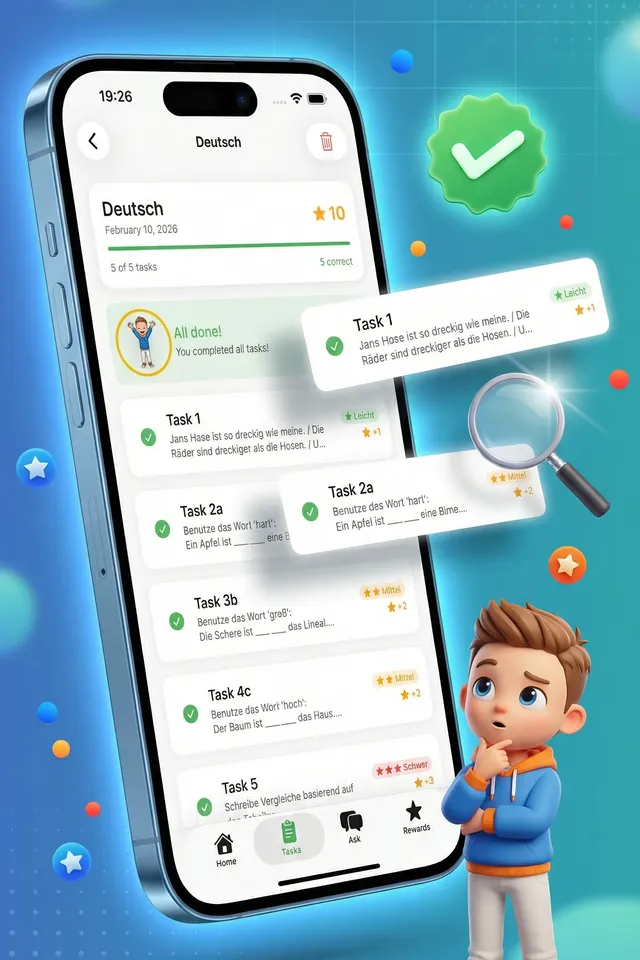
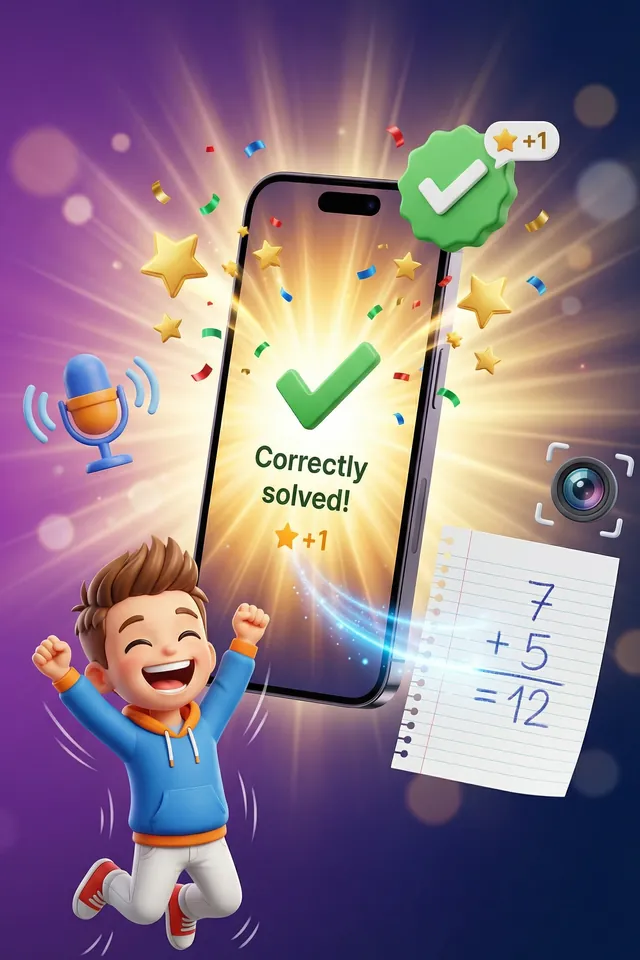
This is where Gennady can help: the app reads the concrete task from the scanned worksheet and explains a simple method step by step in child-friendly language, using the numbers and words from the task. It checks your child’s answer. If the answer is wrong, there are hints first; Gennady shows the correct solution for comparison only on the third try. To be clear: Gennady shows the simplest method, not automatically the method your school is currently teaching; if the workbook asks for a different method, the school’s method takes precedence. If fundamental gaps persist for months, a conversation with the teacher comes first.
Reading is half the math test
What many underestimate: behind some math problems in elementary school there is actually a reading problem. A child that still spends a lot of energy decoding words has no capacity left to understand the content. The word problem then fails in line one, long before the math starts.
That is why strengthening reading pays off twice: reading aloud, reading together, having short texts read out loud. For beginning readers Gennady has a read-aloud feature that reads texts from the worksheet and highlights them word by word. Your child understands the task even while their own reading is still shaky, and trains along-reading at the same time.
What you can do concretely
First: have your child explain the task in their own words before calculating. If they can retell the story, understanding is there. Second: use materials. Buttons, building blocks, drawn pictures make abstract numbers tangible, and in elementary school that is not a step backwards but the royal road. Third: ask the school which methods are being used. Many schools offer parent evenings or handouts, and 20 minutes of reading up saves you months of kitchen-table debates.
And fourth: stay calm when something takes longer. Understanding does not grow linearly. Children who despair over number walls in autumn often build them in their sleep by spring. Pressure does not speed up this process, it slows it down.
In-depth articles on this topic
My child does not understand word problems: causes and exercises
Why word problems fail so often, the role reading plays, and which exercises actually target the problem.
Read moreElementary school math: why it is taught differently today
Number lines, number walls, semi-written methods: what is behind the new approaches and how to deal with them.
Read moreChild Doesn't Understand the Instructions: Causes and Help
20 task words in kid language, a method for asking questions, and when to talk to the teacher.
Read moreChild Reads Fluently but Doesn't Understand: Reading Help
Why that happens, five exercises using the homework text, and when an assessment makes sense.
Read moreChild Won't Read: What Helps in Grades 1 to 4
Why this happens so often, what can help in grades 1-2 and 3-4, and when you should talk to the teacher.
Read more2nd Grade Math: What Should My Child Know? With Checklist
What curricula expect in grade 2 math, with sample problems and a checklist.
Read moreThird Grade Math: What Should My Child Know?
Numbers up to 1,000, written steps, column methods and division with remainder, with examples and a checklist.
Read more
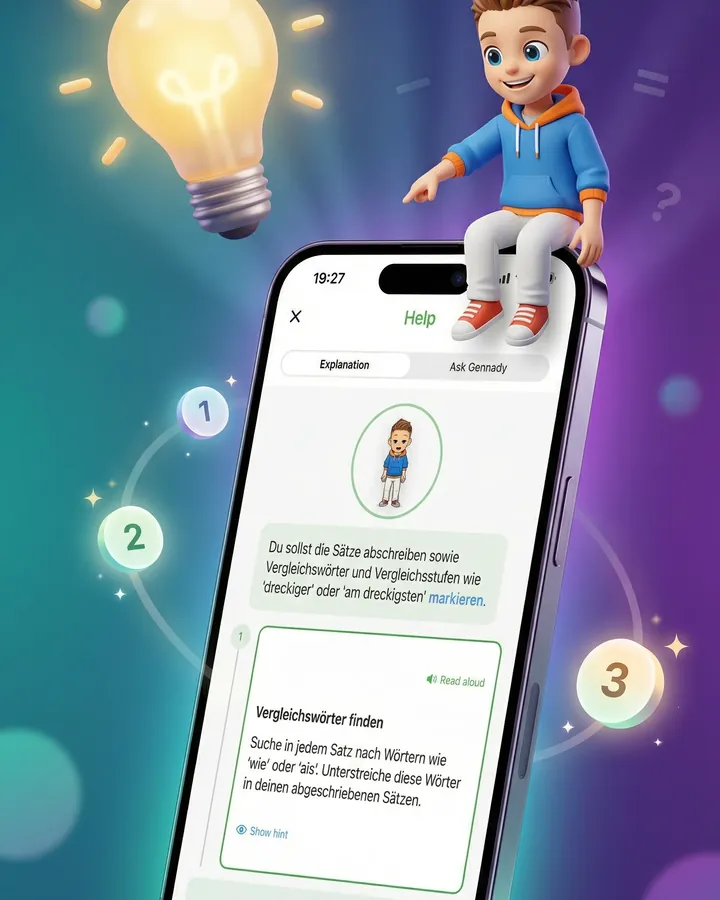
Explains the task that is on the sheet
Gennady scans the worksheet, walks your child through a solution method step by step and then checks their answer. If the answer is wrong, there are hints first; Gennady shows the correct solution for comparison only on the third try.