AI and children: learning safely instead of cheating
Maybe you have seen it already: your child shows up with a phone and the homework is suddenly done, suspiciously flawless and phrased in ways no nine-year-old talks. AI has arrived in the kids room, whether we parents like it or not. The question is no longer if, but how.
This guide helps you understand the difference between AI that hands out answers and AI that explains. And it answers the question many parents of 6 to 11 year olds ask: what works instead of ChatGPT when a child genuinely needs help?
The real problem: handing out answers feels like helping
When a child receives a finished solution, almost nothing happens in their head. The task is done, but nothing was learned. That is the core of the cheating problem, and it is older than any AI: copying from the kid at the next desk works exactly the same way. What is new is that the solution is now available in seconds, for every task, at any time.
A field experiment with nearly 1,000 math students in grades 9 to 11 (Bastani et al., PNAS 2025) points the way: students who had practiced with an unrestricted chatbot later did worse without help than students who never had access; a version with safeguards largely mitigated this. So good help gives the next small step, not the final result. That is what good teachers do, and that is the standard you should hold any AI to that your child uses: does it lead toward their own thinking, or does it take the thinking away?
Why ChatGPT was not built for elementary school children
ChatGPT is an impressive tool, but it is not aimed at elementary school children. OpenAI requires a minimum age of 13, with parental consent from 13 to 17. The parental controls and teen mode are meant for teenagers, and according to the German parenting site familie.de, anyone who enters a false age ends up in the adult version without any technical hurdle. In the standard chat, ChatGPT can provide the solution directly; study mode guides step by step instead, but can be switched off at any time.
Add the hallucination problem: AI models answer confidently even when they are wrong. Adults can weigh that, an eight-year-old cannot. And finally privacy: whatever your child types into a chat window ends up with the provider. That applies to every AI app, so read the privacy policy of any app you use.
This does not mean AI has to be off-limits for children. It means the tools have to be built for children: with a limited topic space, child-friendly language, a pedagogical concept and privacy taken seriously.
How to recognize child-appropriate AI
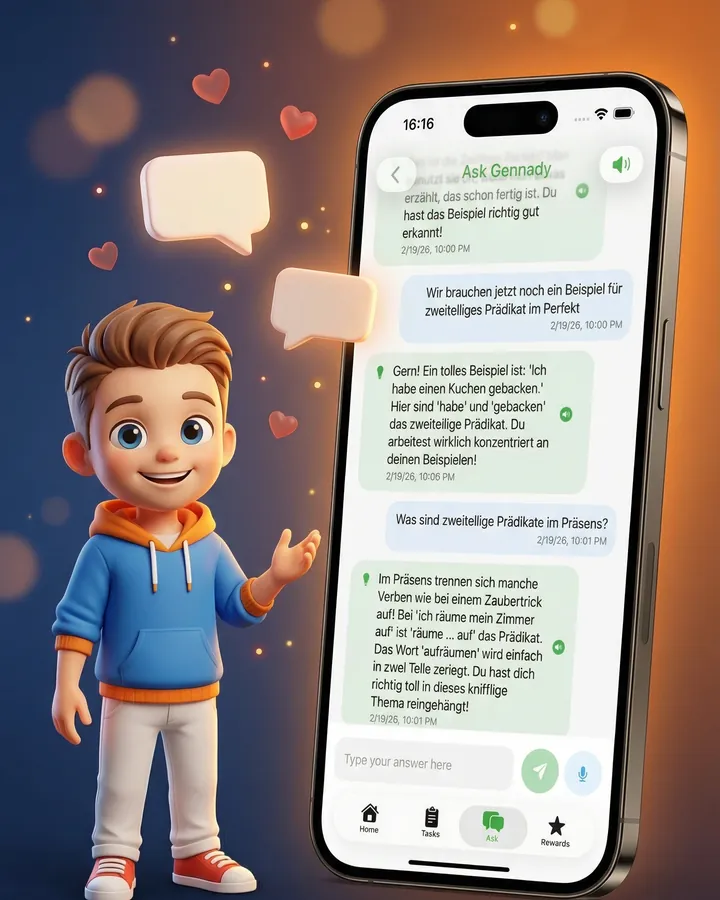
First: it explains instead of solving. The most important question for any homework AI is: what happens when the child enters the task? If the result comes out, it is a cheating tool. If a step-by-step explanation comes out, with a prompt to keep thinking, it is a learning tool.
Second: it speaks the child’s language. Short sentences, familiar words, examples from a child’s world. Third: it stays on topic. A good children’s AI answers questions about schoolwork and politely blocks everything else. Fourth: parents keep an overview, for example through a history of scanned tasks.
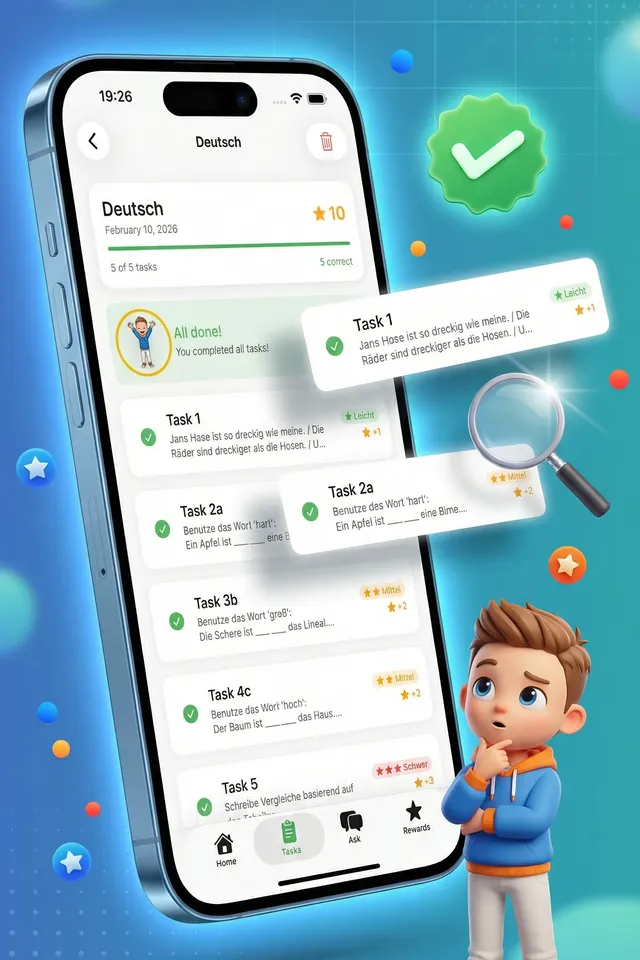
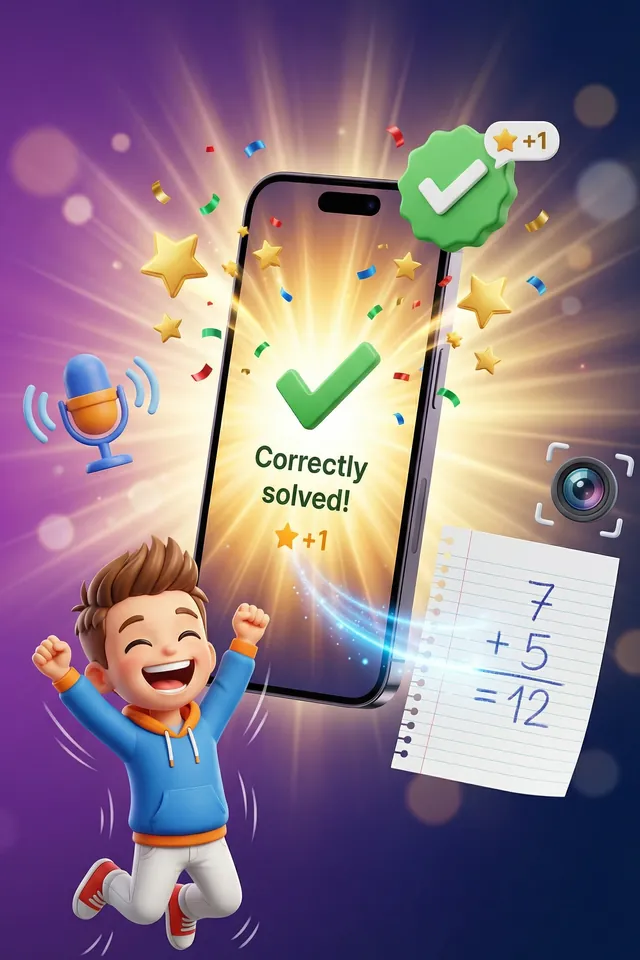
This is what Gennady does today: your child scans the worksheet, Gennady explains step by step in child-friendly language and checks your child’s own answer. If the answer is wrong, there are hints first; Gennady shows the correct solution for comparison only on the third try. The last hint of an explanation leads right up to the result; your child takes the last step on their own. Gennady is a tool, not a replacement for your interest. The best AI rule for families remains looking at things together now and then and letting the child explain what they understood.
Rules that work in families
Bans alone achieve little, because your child will learn what AI can do on the schoolyard at the latest. Clear, simple rules work better: AI may explain, not complete. Homework is written by the child’s own hand. And when something was solved with AI help, the child afterwards explains in their own words how it works.
That last rule is the strongest one, because it makes cheating pointless: whoever can explain has understood. Whoever merely copied gets caught in sentence two, without blame or drama. This turns AI from a secret cheat sheet into a tool your family talks about openly, and that is the best preparation for school years in which AI is not going to disappear.
In-depth articles on this topic
ChatGPT and homework: what parents need to know in 2026
Age limits, risks, sensible rules: the overview for parents whose children have discovered ChatGPT.
Read moreAI and homework: handing out answers or building understanding?
The decisive difference between answer apps and learning AI, and how to spot it in two minutes.
Read moreGennady vs. ChatGPT: the honest comparison
Where ChatGPT is strong, what its age limit of 13 means, and what Gennady does differently. With honest limits on both sides.
Read moreExplaining AI to Kids: Read-Aloud Texts for Ages 6 to 11
Two read-aloud texts for ages 6 to 8 and 9 to 11, plus three rules for home and mini experiments.
Read more
AI that explains the method first
Gennady was built for children aged 6 to 11: scan the worksheet, understand step by step, answer yourself. If the answer is wrong, there are hints first; Gennady shows the correct solution for comparison only on the third try.